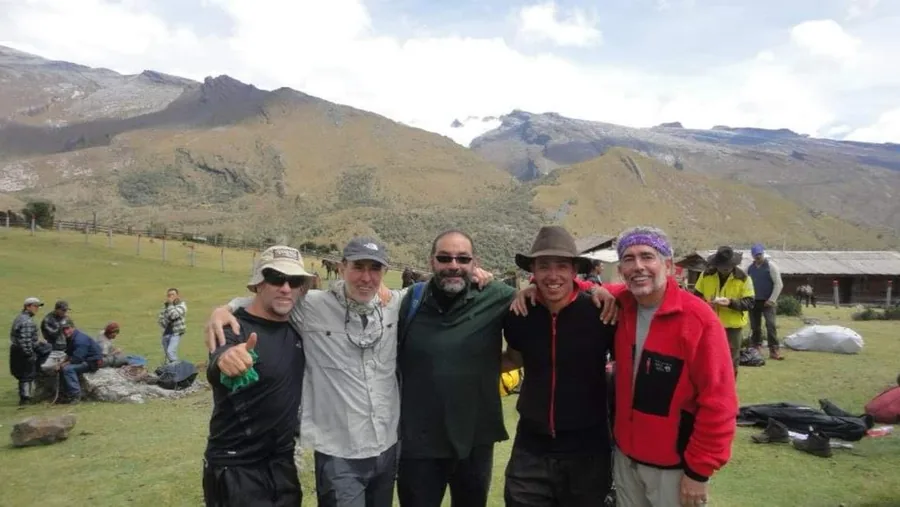
RitakU'wa, high mountain guides in Güicán de la Sierra
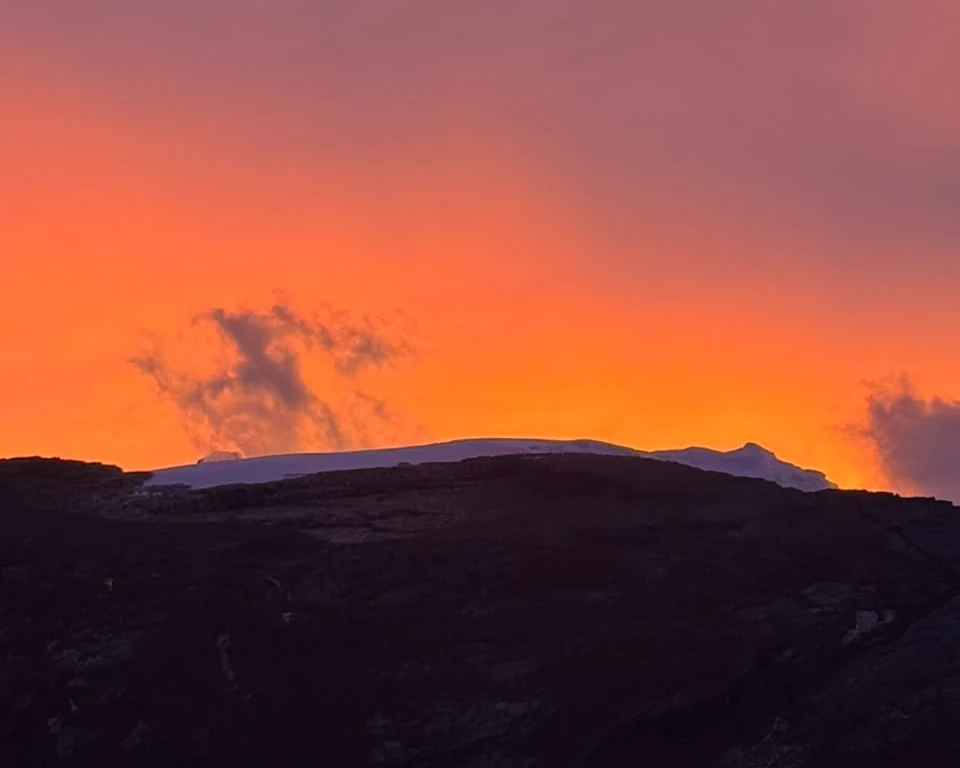
Sunrise over the glacier of the Sierra Nevada del Cocuy, orange sky behind the snow-covered ridge

RitakU'wa – High mountain guides to Nevado del Cocuy from Güicán de la Sierra, Boyacá

We are Camilo and Christiam, brothers, farmers and guides from Güicán de la Sierra, Colombia. Camilo has spent close to twenty years organizing and leading high mountain expeditions in the Sierra Nevada de Güicán, inside El Cocuy National Natural Park; together we have guided since 2009. We climb the three authorized trails, with a maximum of five people per guide. We guide in English.

Park status

Updated on

El Cocuy National Natural Park is open and operating normally, and no closures are expected. All three authorized trails are receiving visitors. The park does close at times because of river flooding, glacier conditions or agreements with the communities: in July 2026 it was closed for a week due to flooding. Before every departure we check the park's status with the authority and let you know.

Entry requires an advance booking, accident insurance issued by an insurer approved by Parques Nacionales, and an accredited guide or interpreter on every trail. We handle the booking and the insurance paperwork for you; the policy is issued by the insurer, not by us.

Our trips and what they cost

Five trips, all departing from Güicán de la Sierra. The price you see is per person and covers the park entrance fee and the cost of the compulsory insurance policy, which we arrange for you: there is no entrance fee or insurance to pay separately on arrival. Prices are in Colombian pesos (COP).

3 days · 2 nights · 1 ascent

Pasa Día

Arrival in Güicán, dinner and accommodation. The next day, 4x4 transfer to Kanwara, La Esperanza or Los Herrera and the climb to the edge of the glacier with a guide approved by Parques Nacionales. Packed lunch on the mountain, a soak in natural hot springs on the way down and return to Güicán. On the third day, breakfast and departure.

$600,000per person, in a group of five

4 days · 3 nights · 1 ascent

Aclimatando

This trip adds a full day of acclimatization before the climb: a walk up cerro de Monserrate, peñón de la Gloria, piedra de la Petaquera, the San Ignacio chapel or the mirador del Torrente, plus a guided visit to the monument to the dignity of the U'wa people, the main square and the murals. That extra day is what decides whether you make it up.

$790,000per person, in a group of five

5 days · 4 nights · 2 ascents

Aclimatando con doblete glaciar

One day of acclimatization and then two climbs to the edge of the glacier on consecutive days, by two different trails. For those who want to see two of the park's three routes in a single trip and already know how their body responds to altitude.

$1,120,000per person, in a group of five

5 days · 4 nights · 1 ascent

Aclimatando doble

Two days of acclimatization, the second climbing up past the parada de Romero to the Kanwara cabins, where you sleep high on the mountain with your luggage brought up by 4x4. The following day you set off for the glacier from up there, with your body already used to the altitude.

$1,180,000per person, in a group of five

7 days · 6 nights · 3 ascents

Trilogía para los pro

The park's three authorized trails, with a day of acclimatization at the start and a rest day in the middle. It is the longest trip we offer and, among the operators we have compared, the only one that lets you choose whether or not to take the rest day: without it the price is $1,360,000 per person.

$1,470,000per person, in a group of five, with rest day

What it costs depending on group size

We publish the full table because it is the first question anyone traveling alone or as a couple asks. The guide and the 4x4 cost the same whether one person goes or five, and that cost is split between those who climb. This is why the price per person drops as the group grows. We do not overcharge the person traveling alone: we charge what it costs.

Prices per person in Colombian pesos, valid for 2026. The five-person column is the base rate for each trip. Parques Nacionales allows a maximum of five visitors per guide: from the sixth person onwards a second guide is required, so for groups of six or more write to us and we will give you the exact figure.
Trip 1 person 2 people 3 people 4 people 5 people
Pasa Día · 3d/2n $1,075,000$780,000$680,000$630,000$600,000
Aclimatando · 4d/3n $1,520,000$1,065,000$910,000$835,000$790,000
Aclimatando con doblete glaciar · 5d/4n $2,330,000$1,575,000$1,320,000$1,195,000$1,120,000
Aclimatando doble · 5d/4n $2,390,000$1,635,000$1,380,000$1,255,000$1,180,000
Trilogía para los pro · 7d/6n $3,155,000$2,100,000$1,750,000$1,575,000$1,470,000

What is included, on every trip

  • Guide approved by Parques Nacionales
  • Park entrance fee and entry permit
  • Arranging the assistance and rescue insurance policy (issued by an insurer approved by Parques Nacionales; its cost is included in the price)
  • Accommodation every night
  • All meals
  • 4x4 transfers
  • Guided visit to the monument to the dignity of the U'wa people, with its full explanation
  • A soak in natural hot springs
  • A keepsake gift

With two or more nights of accommodation, a traditional dinner and a special dinner are also included.

Visitors from abroad: we guide in English and in French. Foreign visitors pay the difference on the park entrance fee ($107,000 instead of $52,500, a rate set by Parques Nacionales), and if you need the guiding itself in English or French there is a 30% surcharge on the price of the trip.

What is not included

  • Transport from your city to Güicán and back
  • Lunch on the day you arrive and on the day you leave
  • Personal equipment: boots, waterproof jacket, gloves and hat (we lend you the trekking poles at no cost)
  • Personal expenses, souvenirs and tips
  • Alcoholic drinks
  • Travel or cancellation insurance other than the park insurance
  • Any service not listed opposite

We publish this list because almost no operator here does. On the first day you arrive in Güicán and the first thing we give you is dinner; on the last day you have breakfast and leave. Those two lunches are on you, and we would rather tell you now than once you are here.

The three authorized trails

Parques Nacionales authorizes only three trails inside the park, each with a maximum number of visitors per day. Those places go quickly in high season, which is why booking ahead is not a formality.

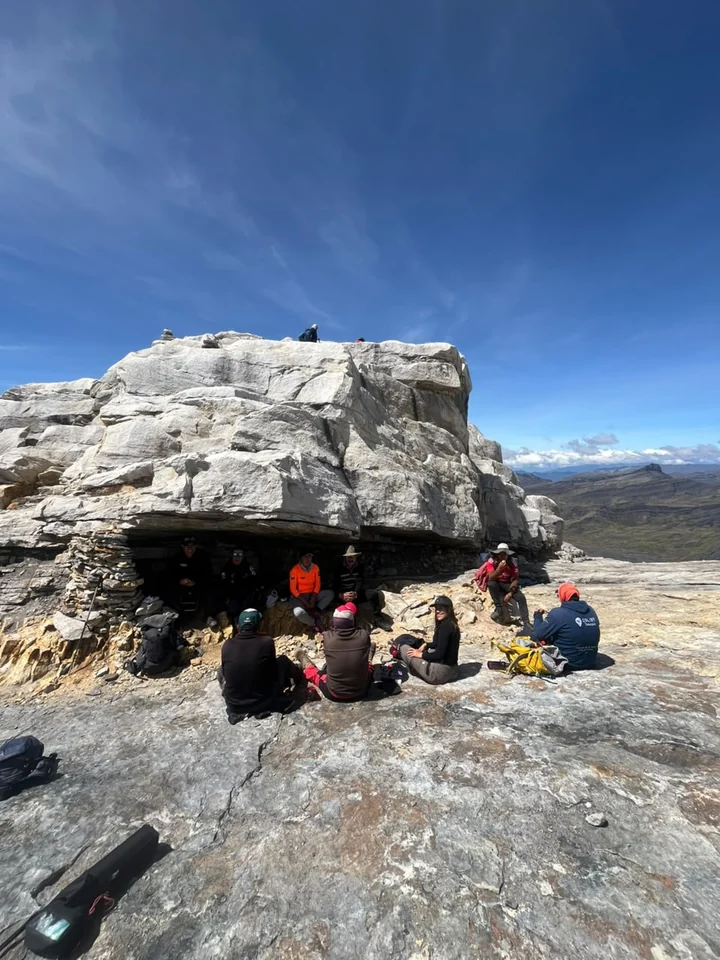
A group resting at the Divino Niño, the highest accessible point on the Ritacuba Blanco trail

Ritacuba Blanco

The shortest of the three and the steepest. It starts beside the Playitas river on a deceptively flat stretch, climbs through las Tres Gemelas —three zigzagging ascents where the mountain tests your pace—, crosses the rocky section and the waterfall, and ends at the moraine. From the Divino Niño, the highest accessible point on the trail, you can see Ritacuba Blanco, Ritacuba Negro, Ritacuba Norte and several lakes. Short in distance, vast in landscape. The descent is long and over rock: this is the trail where poles make the difference.

  • Distance 13.9 km round trip
  • Maximum altitude 4,929 m
  • Approximate duration 7 to 9 hours
  • Official daily quota 49 people
  • Access Güicán de la Sierra
  • Maximum group 5 per guide

See the trips that use this trail

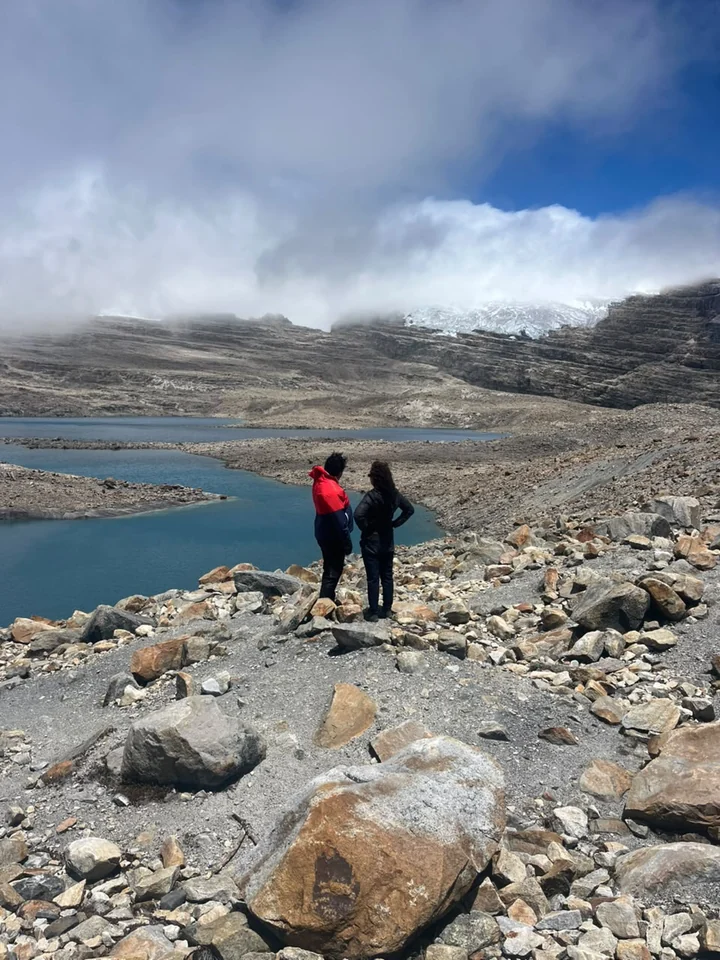
Two hikers in front of the lakes at Laguna Grande de la Sierra, with the glacier among the clouds behind

Laguna Grande de la Sierra

The longest, and the one that does not reveal itself all at once. It begins at the La Esperanza farm, crosses the Valle de los Frailejones and climbs past El Puma, el Tinajo and Laguna Seca to the Cueva de los Hombres. Once you clear the last rocky rise the lakes appear, and with them the Púlpito del Diablo, the Pan de Azúcar, los Portales, el Cóncavo and el Concavito. For many people the goal is met right there; for those with the energy left, another four kilometers lead to the edge of the glacier.

  • Distance 19.6 km round trip
  • Approximate duration ~9 hours
  • Official daily quota 175 people
  • Access Güicán de la Sierra

See the trips that use this trail

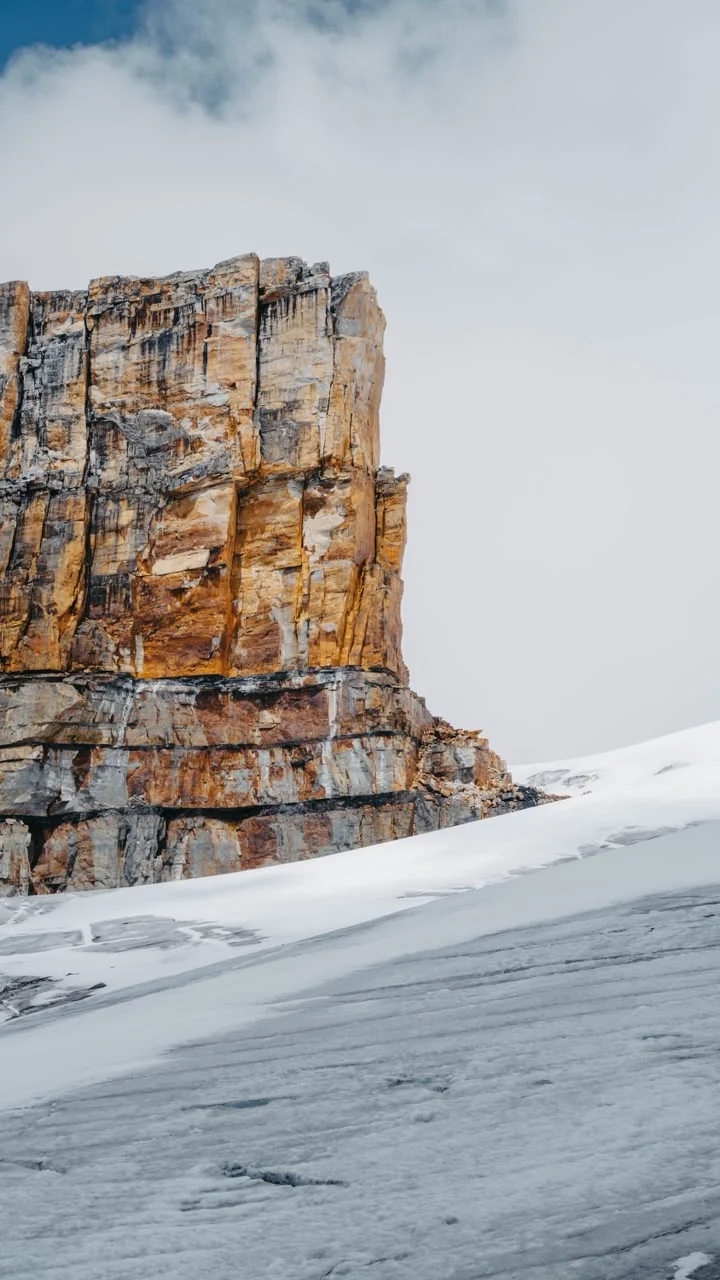
The Púlpito del Diablo, the rock tower rising above the glacier of El Cocuy National Natural Park

Lagunillas – Púlpito del Diablo

The busiest in the park, and the most deceptive. It starts gently among valleys and lakes, and saves its difficulty for later: after a short climb the glacier appears straight ahead —the Púlpito, the Pan de Azúcar and part of Ritacuba Blanco—, and from there the ground turns to rock. You move across slabs to la Grieta, and there are still two kilometers of rock left at around 4,500 meters, where every step costs. It is the only trail where white-tailed deer are seen. Access is through the Alto de la Cueva, on the road between Güicán and El Cocuy.

  • Distance 17 km round trip
  • Maximum altitude 4,830 m
  • Approximate duration ~8 hours
  • Official daily quota 82 people
  • Access Alto de la Cueva

See the trips that use this trail

$52,500Park entrance, Colombian visitor (2026)
$30,500Entrance, Colombians aged 10 to 25
$107,000Entrance, foreign visitor
5Maximum visitors per guide, under park rules

Entrance fees set by Parques Nacionales for 2026, in Colombian pesos. They are included in the price of all our trips, as is the cost of the compulsory insurance, which we arrange: you do not pay them separately.

The peaks you can see, and how high they really are

The Sierra Nevada del Cocuy, Güicán y Chita is the only snow-capped range left in Colombia's Eastern Cordillera, and its ice mass is the largest in the country. In 2022 IDEAM counted 20 summits still carrying snow. The glacier measured 11.88 km² in 2024: it lost 7.41% in just two years. Almost all of those summits can be seen from the three trails. None of them is climbed: the routes end at the edge of the glacier and stepping onto the ice is forbidden.

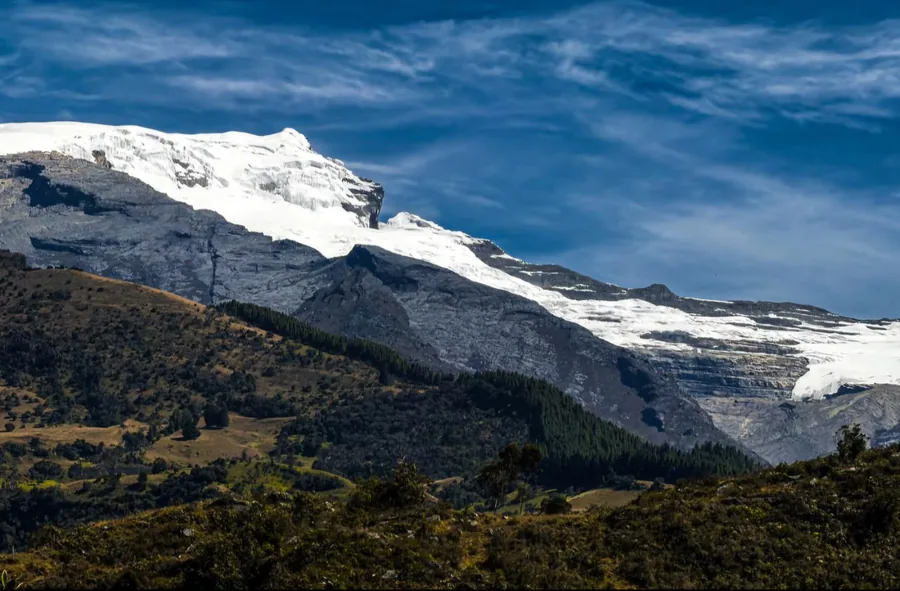
The Ritacuba Blanco glacier seen from the pastures of Güicán de la Sierra, the ice cap above the rock face
The ice cap of Ritacuba Blanco from Güicán de la Sierra. It is the highest point in Colombia's Eastern Cordillera. The Ritacuba trail reaches the edge of that glacier, at 4,929 m.
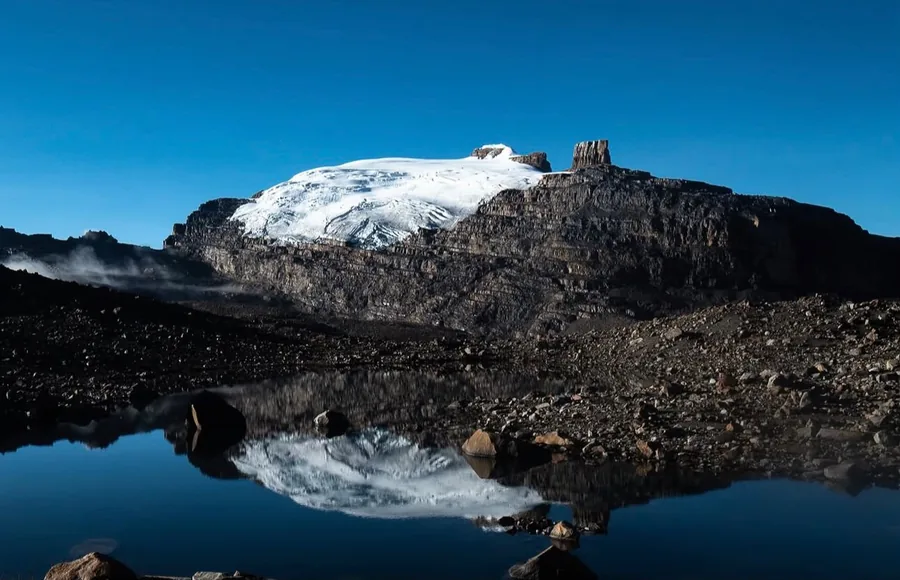
The snow-covered Pan de Azúcar and the rock tower of the Púlpito del Diablo reflected in a lake in El Cocuy National Natural Park
The Pan de Azúcar, with its dome of ice, and to its right the rock tower of the Púlpito del Diablo. This is how they look from the Lagunillas trail and from Laguna Grande de la Sierra.
Altitudes taken from the IDEAM summit table, "Disposición de los glaciares en la Sierra Nevada El Cocuy o Güicán". Those marked IGAC are measurements by the Agustín Codazzi Geographic Institute (2024); those marked DEM are estimates calculated from the SRTM elevation model, which is why we give them as approximate.

At least three figures circulate for Ritacuba Blanco. We publish 5,380, the IGAC figure from 2024. Parques Nacionales uses 5,330 in the text of Auto 002 of 2025, and a figure of 5,410 is widely repeated online that we have not found in any official source. We would rather tell you this than give you a round number and keep quiet about the rest.
SummitAltitudeWhere it can be seen from
Ritacuba Blanco 5,380 mIGAC, 2024. The roof of the Eastern Cordillera. From the town of Güicán and from the whole Ritacuba trail, which ends at the foot of its glacier, at 4,929 m.
Ritacuba Negro 5,350 mIGAC, 2024. From the Ritacuba trail. It is not open to visitors: it is not one of the three authorized trails and climbing its face is forbidden.
Cóncavo 5,200 mIGAC, 2024. From Laguna Grande de la Sierra. The trail ends at the edge of its glacier.
San Pablín Norte 5,200 mIGAC, 2024. From the Ritacuba trail, looking south along the Sierra.
San Pablín Sur 5,180 mIGAC, 2024. From the Ritacuba trail.
Pan de Azúcar 5,100 mIGAC, 2024. Next to the Púlpito del Diablo, from Lagunillas and from Laguna Grande. It is the dome of ice in the photograph above.
Concavito 5,100 mApproximate, DEM. From Laguna Grande de la Sierra, beside el Cóncavo.
Púlpito del Diablo 5,090 mApproximate, DEM. From the Lagunillas trail, which ends at the edge of its glacier, and head-on from Laguna Grande.
Portales 4,900 mApproximate, DEM. From Laguna Grande de la Sierra, as the lakes come into view.

What is told about the Púlpito del Diablo

This sits apart from the table, because it is legend and we give it as legend. The name is said to have been given by the mountaineer Erwin Kraus, after an old story from the region: a devil who rode up on a black mule from the Chicamocha canyon and struck sparks from the rock on Good Friday. It is also said that the Púlpito was called the Temple of the Sun, and that together with Ritacuba Blanco and Malpaso it formed a triangle that served as a solar calendar.

We have found no official document supporting the calendar story, so we are not going to sell it to you as fact. What is certain and verifiable is that this range is sacred territory of the U'wa people, the ancestral owners of these mountains, and that their reservations cover close to half the park. The stories from up here have owners, and they are not us. We tell them to you as we walk, the way they were told to us.

5,380Meters of Ritacuba Blanco, the roof of Colombia's Eastern Cordillera
4,929Meters: the highest point a visitor reaches, at the edge of the Ritacuba glacier
11.88Km² of glacier in 2024, the largest ice mass in Colombia
7.41%What the glacier lost between 2022 and 2024, according to IDEAM

What we take care of

We organize the whole trip so that all you have to do is walk. We operate out of Güicán de la Sierra and out of El Cocuy.

  • Transport
  • Meals
  • Accommodation
  • Park entry booking
  • Arranging the compulsory insurance
  • Guiding on all three trails
  • Rock climbing
  • Hot springs
  • Service in English and French

About the insurance

Parques Nacionales requires accident insurance with assistance cover in order to enter, and does not allow access without it. Only insurers supervised by the Superintendencia Financiera and approved by Parques Nacionales can issue it. We handle the paperwork; the policy is issued by the insurer.

About group sizes

Park rules set a maximum of five visitors per guide. We always comply. A small group is not a luxury in high mountains: it is what makes it possible to adjust the pace and to respond if something happens.

About us

We are farmers from Güicán de la Sierra. We were born here and we live here: these are our roots, not a working season. The mountain you are coming to walk is the one we see every day from the house.

We started guiding in 2009, but we had been climbing in this range long before that. We climbed in sneakers, or in Venus boots. North Face jackets did not exist. We cooked on five-kilo gasoline stoves that had to be carried all the way up. The mountain was our essence and our life, and it still is.

And we do not only know the three trails: we have covered a good part of this range, including the years when you could still climb on snow. We have belonged to the mountain and we always will. We are only passing through: that is why we love what we do and share what we have.

Guiding, for us, is not taking people to a point and bringing them back. It is knowing when the group is doing well and when it is time to turn around. It is looking after the páramo, which takes decades to recover from a single step off the path. And it is respecting the fact that close to half the park is made up of reservations of the U'wa people, the ancestral owners of this range: that is why all our trips include the visit to the monument to the dignity of the U'wa people, and why we climb with a maximum of five people per guide, which is also the park rule.

We are both guides. What differs is what each of us adds to the walk.

Camilo reads it through nature: the biodiversity of the páramo —which frailejón is which, whose call that was, why that plant only survives at that altitude— and the ethnoculture of the range, the history of the U'wa people who named almost everything you will see up there. With him, the walk stops being only a climb.

Christiam is a professional tourism guide with a professional license and works trilingually: Spanish, English and French. He is also a volunteer firefighter and rescuer and holds certified first aid training. At four thousand meters and hours from town, that last part is what really counts when something goes wrong: not the qualification, but knowing what to do in the first twenty minutes.

He has also handled camp logistics for professional mountaineers in this range, among them Juan Pablo Ruiz Soto —the first Colombian to summit Everest without supplemental oxygen, the only one to have done it twice and the one who completed the Seven Summits, who died in 2023— and Marcelo Arbeláez, who reached Everest alongside him in 2001. Setting up and holding a high camp for people like that is not something you improvise.

And we do not work alone. When the group calls for it we climb with other guides from here, with the same training and the same way of treating people: people from this mountain, who know the territory because they grew up in it. We do not bring in guides from elsewhere to work in our own home.

Three things we do that appear on no price list. We pick you up in town, we do not leave you hunting for the meeting point. We give you coffee or herbal tea high on the mountain, which at four thousand meters and in the cold is no small thing. And we make sure you cross paths with the farming communities here: that you know who lives on these slopes, and how. The tourism we care about gives something back where it goes — it is not a parade of people climbing up to take a photograph.

And things happen that nobody plans. We once guided a Polish man and a South African woman who got engaged at Playitas, beside the river where the Ritacuba trail begins. It was on nobody's itinerary. We have been climbing for years and what people decide to do once they get up there still surprises us.

We provide tourism services in Güicán de la Sierra under National Tourism Registry (RNT) no. 91667.

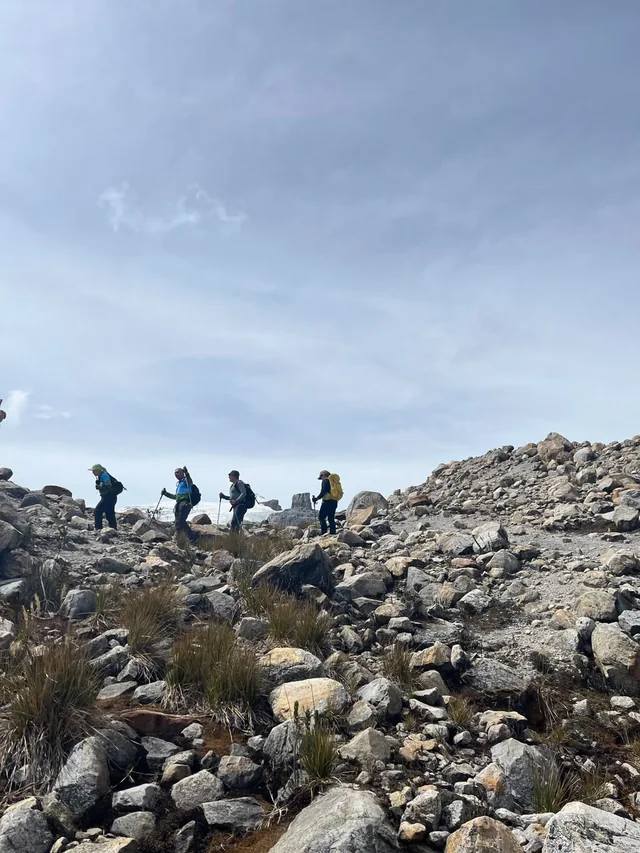
A group walking in single file across the moraine of El Cocuy National Natural Park, with the Púlpito del Diablo behind

One of our groups crossing the moraine, with the Púlpito del Diablo behind.

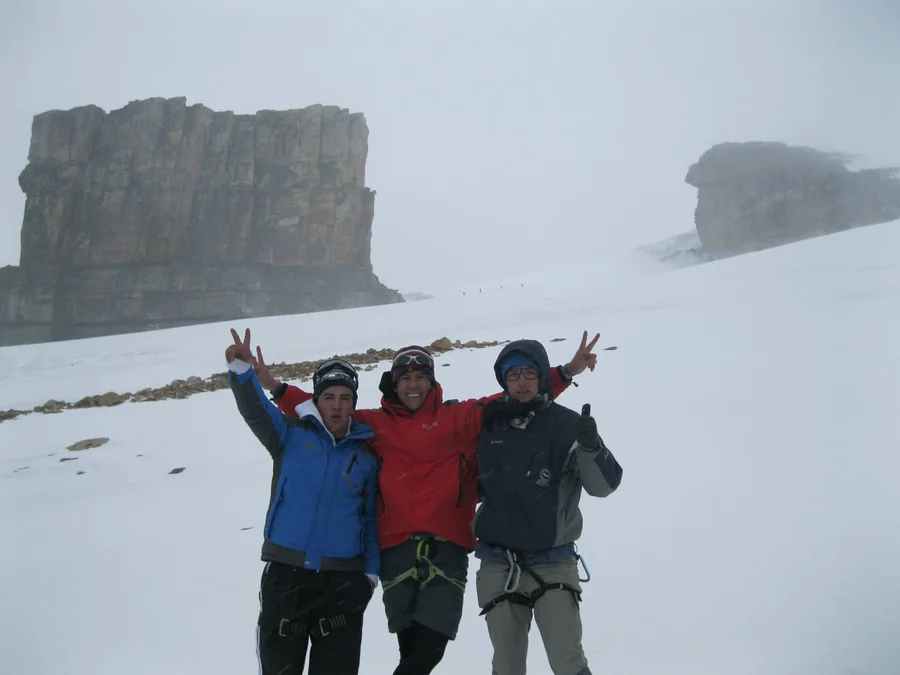
The two brothers and their cousin Juan Blanco on the glacier, with the Púlpito del Diablo behind, in the years when climbing onto the snow was permitted

The two of us with our cousin Juan Blanco, in the middle, on the glacier facing the Púlpito del Diablo. From the years when climbing onto the snow was still allowed; not any more.

Base camp at the foot of the Sierra Nevada del Cocuy, with a mountaineering expedition gathered in front of the snow-covered mountains

Base camp at the foot of the range, on one of the expeditions whose logistics we handled.

Frequently asked questions

How much does entry to El Cocuy National Natural Park cost?

In 2026 entry costs $52,500 for Colombian visitors over 25, $30,500 for Colombians aged 10 to 25 and $107,000 for foreign visitors, according to the rates published by Parques Nacionales (Resolution 551 of 19 December 2025), in Colombian pesos. On top of that come the compulsory insurance and our services.

The ticket is valid for four days and covers all three authorized trails with a single payment. In other words: anyone doing the trilogy pays the entrance fee once, not three times. On our trips the entrance fee is already included, so this does not change your price; we tell you so that you know why charging three entrance fees for the trilogy has no basis in the rules.

Do you charge foreign visitors differently?

The price of our service is the same for everyone. Two things change:

The park entrance fee. Parques Nacionales charges foreign visitors $107,000 instead of the $52,500 charged to Colombian visitors. That difference is paid by the foreign visitor, and the rate is set by the park, not by us.

Guiding in another language. If you need the guiding to be in English or French, there is a 30% surcharge on the price of the trip, because it means interpreting throughout the whole journey and not just translating on arrival.

Do I have to hire a guide?

Yes. The park requires an accredited guide or interpreter on all three trails, with a maximum of five visitors per guide. It is not optional and it does not depend on the trail.

How many hours does each trail take?

As a reference: Ritacuba around 7 hours, Lagunillas – Púlpito del Diablo around 8 and Laguna Grande de la Sierra around 9. But these are very relative figures and are best treated as such: the real time depends on the group's fitness and on how each person responds to the altitude. A trained group beats those times; a slow one exceeds them. We do not rush anyone — in high mountains, hurrying is what stops people from getting there.

If someone in the group cannot go on, what happens?

It matters that you know this before booking: groups are a maximum of five people with one guide, and if someone falls ill or cannot continue halfway, the most likely outcome is that the whole group has to turn back. That is the protocol and it is not a policy of ours: with a single guide you cannot split the group on the mountain, because leaving people alone at that altitude turns a setback into an emergency.

This is why we insist so much on acclimatization and physical preparation. It is not only for you: it is for the other four. And it is also why, if you travel as a closed group of friends or family, it is worth considering — that way nobody depends on a stranger's fitness.

Does the insurance cover rescue if I cannot get down on my own?

It depends, and we would rather tell you now than argue about it afterwards. The rescue is carried out by a team of high mountain guides, supported by horses. When the group gets back down to town, a doctor certifies whether what happened is something the policy covers. If it is certified, the insurance covers it. If it was not a medical emergency, the service is paid directly to the team that went up.

We say this because it happens often: someone with cramps or extreme fatigue asks for a rescue, and then gets upset when the doctor does not certify it and they have to pay. Nobody is acting in bad faith — it is that the policy covers accidents and emergencies, not exhaustion. Knowing this in advance avoids an unpleasant surprise, and it is another reason to train before you come.

If it is my first time, which trail do you recommend?

Ritacuba. It sounds odd to recommend the one that goes highest, but it is the shortest of the three and that counts for more than the altitude: 13.9 km round trip against the 19.6 of Laguna Grande. Fewer hours on the mountain means less wear and more margin if the weather turns.

That said, what really changes the experience is not which one you choose: it is arriving acclimatized and having walked beforehand. Anyone without the habit of walking ends up sore or injured, and then the trip stops being a trip. That is why we almost always recommend the plan with a day of acclimatization rather than the shortest one.

How high is Ritacuba Blanco?

5,380 m, according to the 2024 IGAC measurement published by IDEAM in its table of summits for the Sierra. It is the highest point in Colombia's Eastern Cordillera. It is worth knowing that other figures circulate: Parques Nacionales uses 5,330 in the text of Auto 002 of 2025, and a figure of 5,410 is widely repeated online that does not appear in any official source. Neighboring Ritacuba Negro is 5,350 m. Neither is climbed: the authorized trail ends at the edge of the Ritacuba Blanco glacier, at 4,929 m, at the spot known as the Divino Niño. You have them all in the summit table, with the source for each figure.

Can you walk on the snow or the glacier?

No. Stepping onto the glacier, sliding on it or otherwise interfering with it is forbidden, under Resolution 125 of 5 March 2020 of Parques Nacionales. What you can do is reach the edge of the glacier, and that is done on all three authorized trails. The ban protects an ice mass that is already retreating; reaching the edge and seeing it up close is still the moment of the trip.

What are the park's entry and exit times?

Entry is between 6:00 and 8:00 in the morning. The descent from the edge of the glacier must begin by 1:00 in the afternoon at the latest, and nobody may remain inside the park after 5:00 in the afternoon. That window is not a habit of ours: it is the rule, and it exists because high mountain weather changes after midday.

Where does each trail start?

Ritacuba Blanco and Laguna Grande de la Sierra are entered from Güicán de la Sierra: the first from the Kanwara or Posadas cabins, and the second from the La Esperanza farm, reached via La Capilla. Lagunillas – Púlpito del Diablo is entered through the Alto de la Cueva, on the road between Güicán and El Cocuy. We operate out of both municipalities, so the starting point does not change the trip.

Where do we meet on the first day?

At our office: Carrera 4 # 5-09, barrio La Inmaculada, Güicán de la Sierra. If you are asking for directions, it is a block and a half from the main square, on the road that goes toward San Roque. It is the same address as in the footer and the same one that appears on Google: there is no second office and no different meeting point.

If you arrive by bus, tell us the time and we will pick you up in town. We will not leave you looking for us with your pack on your back.

What time should we leave Güicán?

There is no compulsory time, but from experience we recommend leaving Güicán between 4:00 and 5:00 in the morning so as to start walking between 5:30 and 6:00. That way you reach the entrance just as the park opens and there is plenty of margin for the descent, which has to begin by 1:00 in the afternoon at the latest. Leaving later means walking against the clock, and in high mountains hurrying is what stops people from getting there.

What insurance is needed and who issues it?

Parques Nacionales requires accident insurance with assistance cover in order to enter, and without it access is not allowed. It covers rescue, medical expenses and accidental death. Only insurers supervised by the Superintendencia Financiera and approved by Parques Nacionales can issue it. We tell you which one is current at the time of your booking. We handle the paperwork for you; the policy is issued by the insurer, not by us.

How long and how demanding is the walk to Laguna Grande de la Sierra?

It is about 19.6 kilometers round trip —9.8 each way, of which 7 are inside the protected area, according to the park's Ecotourism Management Plan— and takes between 8 and 9 hours of walking. For comparison: the Ritacuba trail is 13.9 km round trip and the park estimates 7 to 9 hours, ending at the edge of the glacier at 4,929 m; Lagunillas – Púlpito del Diablo is about 17 km and close to 8 hours. None of the three requires climbing technique, but all three are long days of sustained effort at altitude.

Can I do more than one trail on the same day?

No. It is not that it is forbidden: it is that each trail has a different entrance, far from the others, and each one is a full day —Laguna Grande is between 8 and 9 hours of walking. You have to be back before the park closes at 5:00 in the afternoon, having started the descent at 1:00. One trail per day is what fits in the park's timetable.

Is there a briefing to attend before going up?

Yes, and it is compulsory. The park runs an induction briefing the day before the ascent and without it you are not allowed up: the rule states that a visitor cannot enter on the same day they register. That is why you have to arrive in Güicán a day early, and it is not a whim of ours. The park runs it from 8:00 to 8:45 in the morning and from 4:00 to 4:45 in the afternoon. We tell you the time and make sure you are registered.

Can you camp inside the park?

No. Camping is not permitted on any of the three trails: each route is entered and left the same day. That is why accommodation is always outside the protected area: in Güicán de la Sierra, or in the Kanwara cabins on the trip that includes them.

How far in advance do I need to book?

Parques Nacionales asks for places to be booked at least 90 days in advance. The daily quota is limited by rule —49 people on Ritacuba, 82 on Lagunillas and 175 on Laguna Grande— and it fills up in high season. Ritacuba is the hardest to get because it has the smallest quota. Write to us as soon as you have dates: we make the booking.

How many days do you need to visit El Cocuy?

Since each trail takes a full day and it is better to acclimatize first, the trip is built from walking days plus acclimatization days. In practice: three days is the minimum to climb once; four if you want a day of acclimatization beforehand, which is what we recommend; five to do two ascents or to sleep a night high on the mountain; and seven for all three trails with a rest day in the middle. You can see it trip by trip in our trips and prices.

When is the best time to come?

There is no bad month: there are two distinct seasons and each has something to offer. December to March tends to be the dry season in the range: days usually start sunny and clear, which is when the peaks are seen best. Easter week and August tend to be wetter, colder and cloudier, but that is when snow usually falls, and many people prefer that to the sun. The mountain guarantees none of this on any day of the year. Choose according to what you want to see; we climb in both.
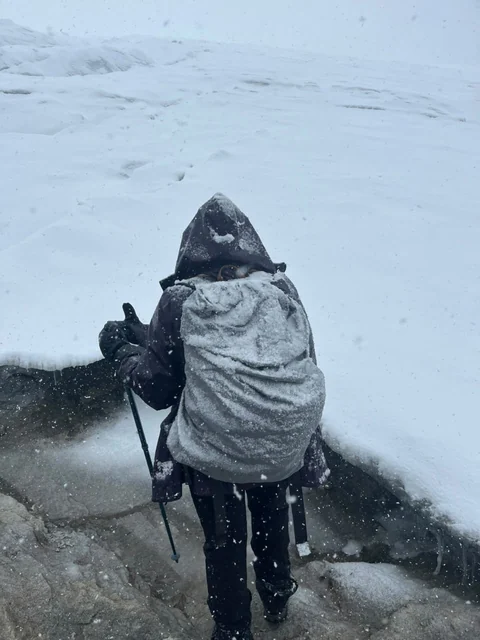
A hiker climbing Ritacuba with a snow-covered pack, during a snowfall

Climbing Ritacuba in the wet season. This is what the range looks like when it snows.

How many people climb El Cocuy each year? Will it be crowded?

We can answer with figures because we requested them from Parques Nacionales through a freedom-of-information request (file 20255680001271, of 9 May 2025). Nobody else publishes them.

The park received 31,520 visitors in 2023 and 30,917 in 2024. But the average is misleading, because they are very unevenly spread: January alone accounts for about 5,600 —more than double an average month, which is around 2,600— and December is close behind. September is the emptiest month of the year, with 1,246 visitors in 2023 and 958 in 2024; February, May and October also stayed under two thousand in both years.

In practice: if space and solitude matter to you, avoid January, Easter week and December. If you can come in September or October, you will walk with the range almost to yourself, in exchange for a higher chance of cloud. We climb all year round and we will tell you frankly how things look for the dates you have.

One figure for visitors from abroad: only 4% of visitors are foreign —1,249 out of 30,917 in 2024. This is not a destination overrun by international tourism: it is a destination for Colombians. Among foreign visitors, the country that sends the most is France, well ahead of the rest.

How do you get to Nevado del Cocuy from Bogotá?

From Bogotá you leave from the Salitre Terminal and the route goes through Tunja, Duitama, Soatá and Boavita to Güicán de la Sierra. The journey takes between 10 and 12 hours. The companies covering the route are Libertadores and Expreso Paz del Río, with departures around 6:00 a.m. and at night, and the fare is around $90,000 to $115,000 in Colombian pesos. The price varies by season, so check it with the company before traveling; it is not something we control.

If you cannot get a direct bus, you can travel in stages: Bogotá–Soatá or Bogotá–Duitama, and from there Duitama–Güicán with Cotradatil, which runs to specific timetables. Ask us and we will tell you which ones are running that week.

From Bucaramanga the route is via Málaga and Capitanejo. Note that the road through El Espino is under maintenance, so the connection currently runs via San Mateo to Güicán.

If you tell us your arrival time, we will be waiting for you in Güicán.

What clothing and equipment should I bring?

The rule is three layers: a base layer that is not cotton, an insulating layer and a waterproof jacket over the top. Up there it rains, it is sunny and it is cold on the same day, and what solves that is not one very thick garment but being able to take layers off and put them back on.

In addition, as a precaution and whatever the season: gloves, sunglasses and a warm hat. In sunny season, a wide-brimmed hat is better than a cap —at 4,000 meters the sun really burns— plus sunscreen. Water bottle: most of the water in the park is drinkable, so there is no need to carry liters up from town.

One favor: please avoid cans and single-use plastics for your snacks. Everything that goes in has to come back out, and the park is working to eliminate single-use plastic. The less packaging you carry up, the better for everyone.

What equipment do you lend and what does the client have to bring?

Let us be clear so that nobody arrives to a surprise: we do not lend personal equipment. Clothing, boots and backpack are each person's own, and we do not rent out jackets or boots.

The exception is trekking poles: those are lent on every trip, at no cost. Use them. The descent from Ritacuba is long and over rock, and that is where poles make the difference between arriving fine and arriving with your knees wrecked.

What is the minimum age for the ascent?

From the age of 12 you can enter the park. But age is not what decides it: fitness is. It is a long, hard and rugged path, at altitude and with weather conditions that can turn adverse at any moment.

We do not turn anyone away over a number. We will ask you frankly about how much walking you do, and if we think someone will not make it, we say so before they buy the trip and not halfway up the mountain. A day of acclimatization beforehand changes the experience more than anything else.

Where do you stay in Güicán and El Cocuy?

You do not have to look for or book anything: accommodation is included on all our trips, every night. You sleep in Güicán de la Sierra, and on the Aclimatando doble trip you also sleep one night in the Kanwara cabins, high on the mountain, with your luggage brought up by 4x4.

The room is private to your booking group: we do not put you in with strangers. And there is hot water, which after a day on the glacier is no small detail.

We do not publish the names of the places because we work with several and assign according to group size and availability on the date. If you need something in particular, say so when booking and we will arrange it.

Write to us

We answer on WhatsApp, in English, Spanish and French. We answer in English.

WhatsApp 313 381 5827 WhatsApp 312 304 3557

Office hours are Monday to Sunday, 8:00 a.m. – 6:00 p.m. In practice we are available almost all the time: if we do not reply straight away it is because we are on the mountain, but we answer as soon as we are back down. Do not let the hour stop you from writing.

RitakU'wa
Carrera 4 # 5-09, barrio La Inmaculada
Güicán de la Sierra, Boyacá, Colombia
A block and a half from the main square, on the road that goes toward San Roque.
WhatsApp: 313 381 5827 · 312 304 3557
Email: hola@guiasdelcocuy.com
Hours: Monday to Sunday, 8:00 a.m. – 6:00 p.m.
RNT 91667